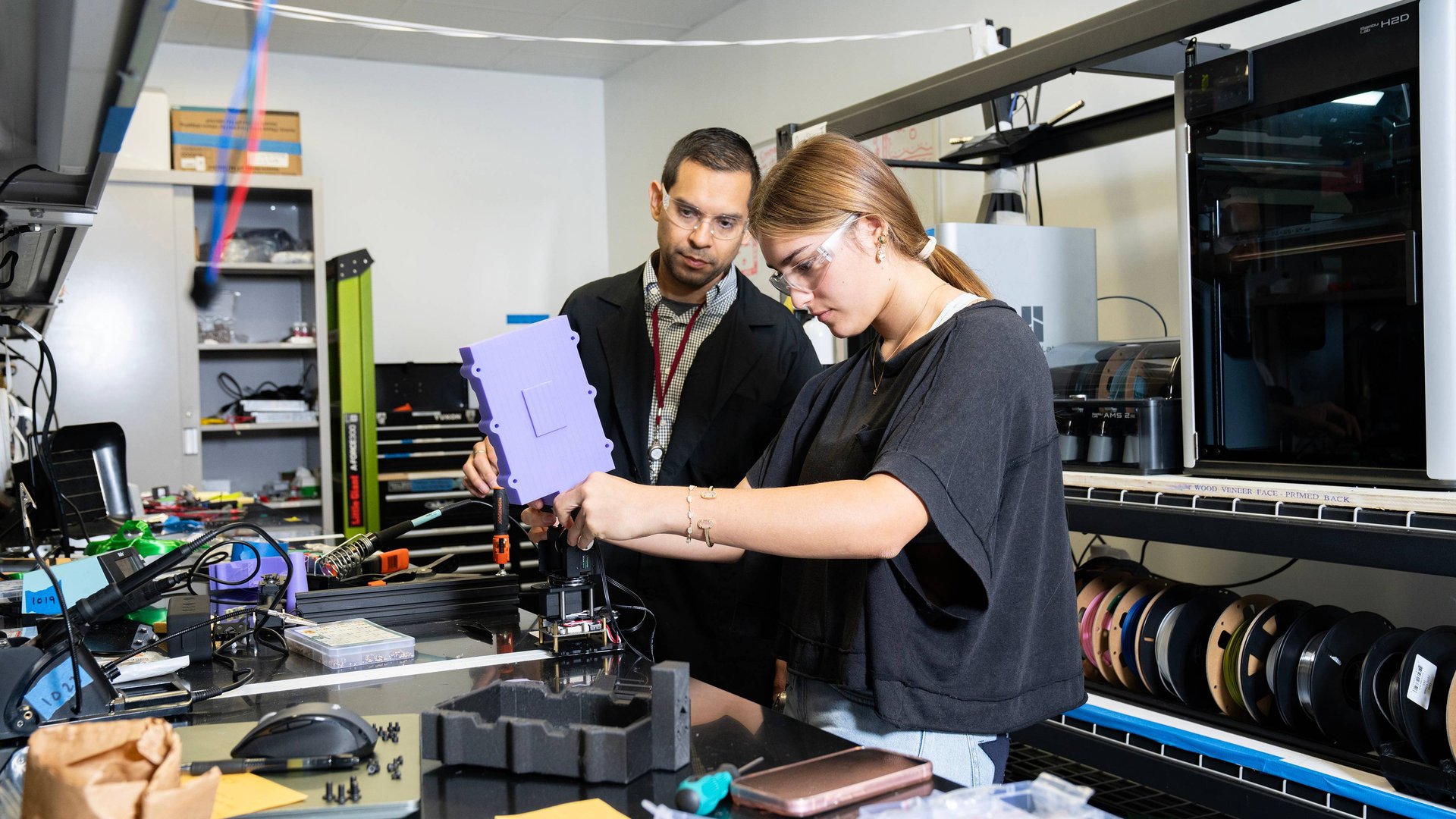
For Chris Reyes and Scott Barrett, PREM at Texas State University helped shape research paths that eventually converged at the same battery startup.
Reyes, a former PREM student, earned his Ph.D. at Duke University and completed a postdoc at Rice University before co-founding Material Hybrid Manufacturing. His doctoral work focused on developing a method to 3D print a complete lithium-ion battery.
“I think one of the keys is mentorship,” Reyes said. “You may have the idea, but not all the pieces. And the networking is key for that.”
Material is headquartered at STAR Park, Texas State’s 58-acre research and innovation site and home to the STAR One technology incubator. The company is developing technology to 3D print rechargeable batteries in custom shapes, allowing the battery to be integrated directly into a product rather than housed in a conventional battery pack.
Meanwhile, Barrett’s PREM research centered on light-active compounds including azobenzene and expanded into energy storage and organic battery fabrication. Collaboration with faculty such as William Brittain and Christopher Rhodes — both professors at Texas State’s College of Science and Engineering — helped shape his dissertation. When Barrett sought an internship, Brittain connected him with his former student Reyes.
Barrett joined Material as a chemistry intern in summer 2025, scaling a nanowire reaction from 5 liters to 20 liters and helping advance battery production from coin cells to multilayer pouch cells. After earning his Ph.D. in 2026, he joined full time as senior battery scientist.
“The willingness to fail, and continue to grow through that failure built strength and confidence in myself as a scientist,” Barrett says. “PREM truly gave me the chance to fail and succeed with guidance through the entire education process.”