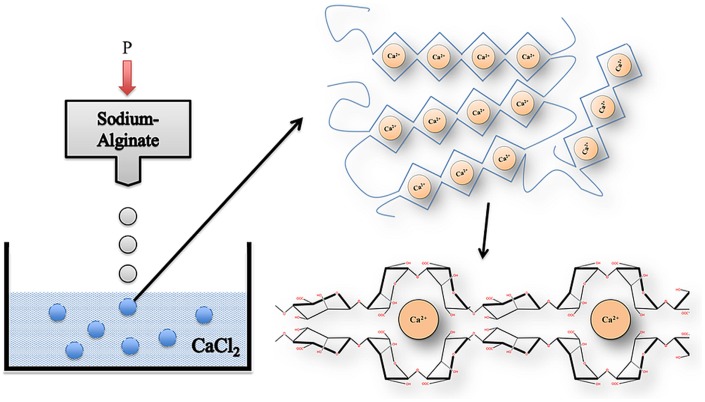
Drops of alginate solution with food coloring in it are added to a calcium chloride solution, where each drop forms a bead. The beads are then moved to clean water, and the color comes out slowly. This stands in for a hydrogel that releases a drug.
Hydrogels are already used in medicine as contact lenses and wound dressings. They are now being looked at for drug delivery and tissue engineering.
What you need
- Sodium alginate
- Calcium chloride or calcium lactate
- Food coloring
- Water and cups
- A dropper or syringe
- Craft sticks for stirring, and a spoon
Food-grade alginate and calcium salts are sold online. The alginate takes a while to dissolve, so prepare the solution the day before if you can.
What is happening
Alginate is a long molecule taken from seaweed. It has a negative charge in water. Calcium ions have two positive charges, so they link the alginate chains together and form a gel.
The food coloring is trapped in the gel and comes out slowly in clean water. Drug delivery agents work the same way. They hold a medicine and release it over a long period, which makes the drug more effective and safer.
Questions
- Can you change how firm the gel is by changing the alginate or calcium chloride concentration?
- Can you make the release faster or slower the same way?
- Where else could this be used: food, agriculture, medicine, cosmetics?
Safety
Do not eat gels made from materials that were stored or prepared in a laboratory, because they may be contaminated. Made at home with food-grade ingredients, they are safe to eat.
Demonstration Sheet (PDF)
 Download