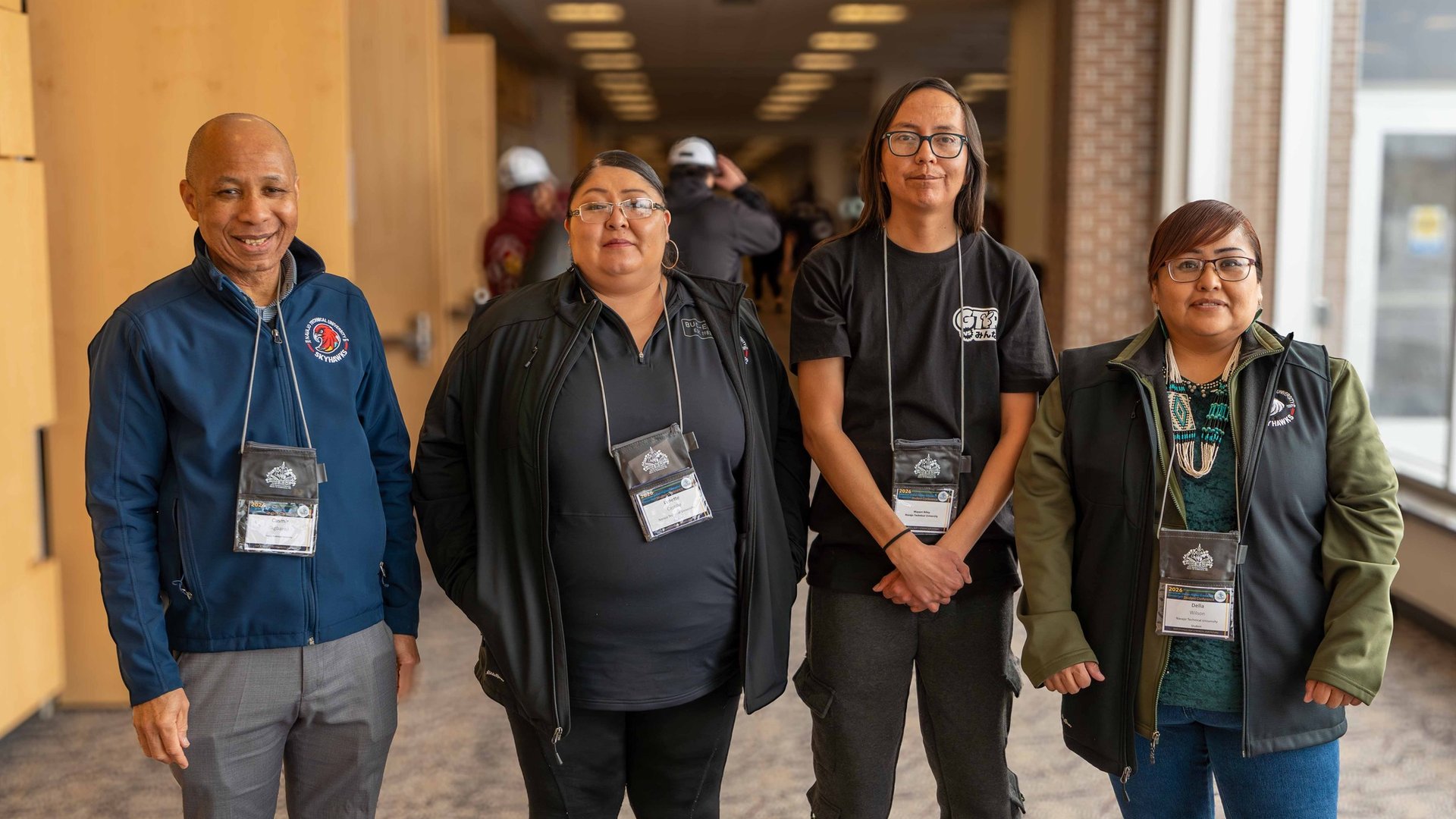
Wayant Billey regularly drives more than an hour for drinking water.
For Billey, a 33-year-old Navajo student from the Standing Rock community in New Mexico, water quality is not an abstract research question. It is part of daily life.
“I live about maybe 10 miles off the road … I don’t really have the amenities that a lot of people have, such as having running water and a reliable heating source. So, I do a lot of water hauling on my day-to-day basis,” says Billey.
Many families in his area haul water for drinking, livestock and crops, often from sources that may not be safe to consume. Billey has seen how deeply those concerns shape life on the reservation. Now, through his research at Navajo Technical University, he is working on tools that could help communities better understand what is in their water.
Billey is a B.S. student in chemistry at Navajo Technical University, where he works in the lab of Thiagarajan Soundappan, associate professor in NTU’s School of Science and PI for PREM VENTURES — a collaboration between NTU and Harvard University.
Billey’s research focuses on small, low-cost electrochemical sensors made with laser-induced graphene, or LIG, a porous carbon material created by laser-engraving polymer film. The sensors are designed to detect contaminants such as heavy metals, including arsenic, cadmium, lead and copper.
The work builds on earlier paper-based sensors Billey learned to fabricate in the lab. Those devices required wax printing, heating and hand-coating with conductive carbon ink. LIG sensors, by comparison, can be made more quickly and at a smaller scale by engraving cleaned Kapton film with a laser cutter. Billey said microscope images of the LIG material revealed a highly porous structure that appears to help with sensing.
Billey recently won first place at NTU’s 13th Annual Research Day for his project, “Fabrication of Laser-Induced Graphene-Based Electrochemical Sensors for Heavy Metal Detection and Environmental Monitoring.” He also won first prize for an oral presentation of his research at the American Indian Higher Education Consortium (AIHEC) spring 2026 conference — an annual event that highlights Indigenous student achievements.
After first testing the sensors with biomarkers, Billey and the NTU team began adapting them for heavy metal detection by adding gold nanoparticles to the electrode surface. More recently, Billey brought local groundwater samples into the lab and observed a response consistent with copper, though the team is still calibrating the sensors and determining what levels are significant or unsafe.
For Billey, the research is also closely tied to community outreach. As founder and president of NTU’s Electrochemical Society student chapter, he hopes to help more students and community members understand how chemistry can be used to address local challenges. PREM support, he says, has helped make that possible by expanding access to equipment, training and research opportunities at NTU. Billey was also able to do an internship with Harvard University as a result of the collaboration.
He also sees the work as part of a larger path — one that may include graduate study, continued research, and eventually a company or teaching role that brings more STEM opportunities back to the reservation.
“I want to be able to explain to these younger generations that high school is not the last step,” says Billey. “That’s just the beginning step of getting out there into the world.”