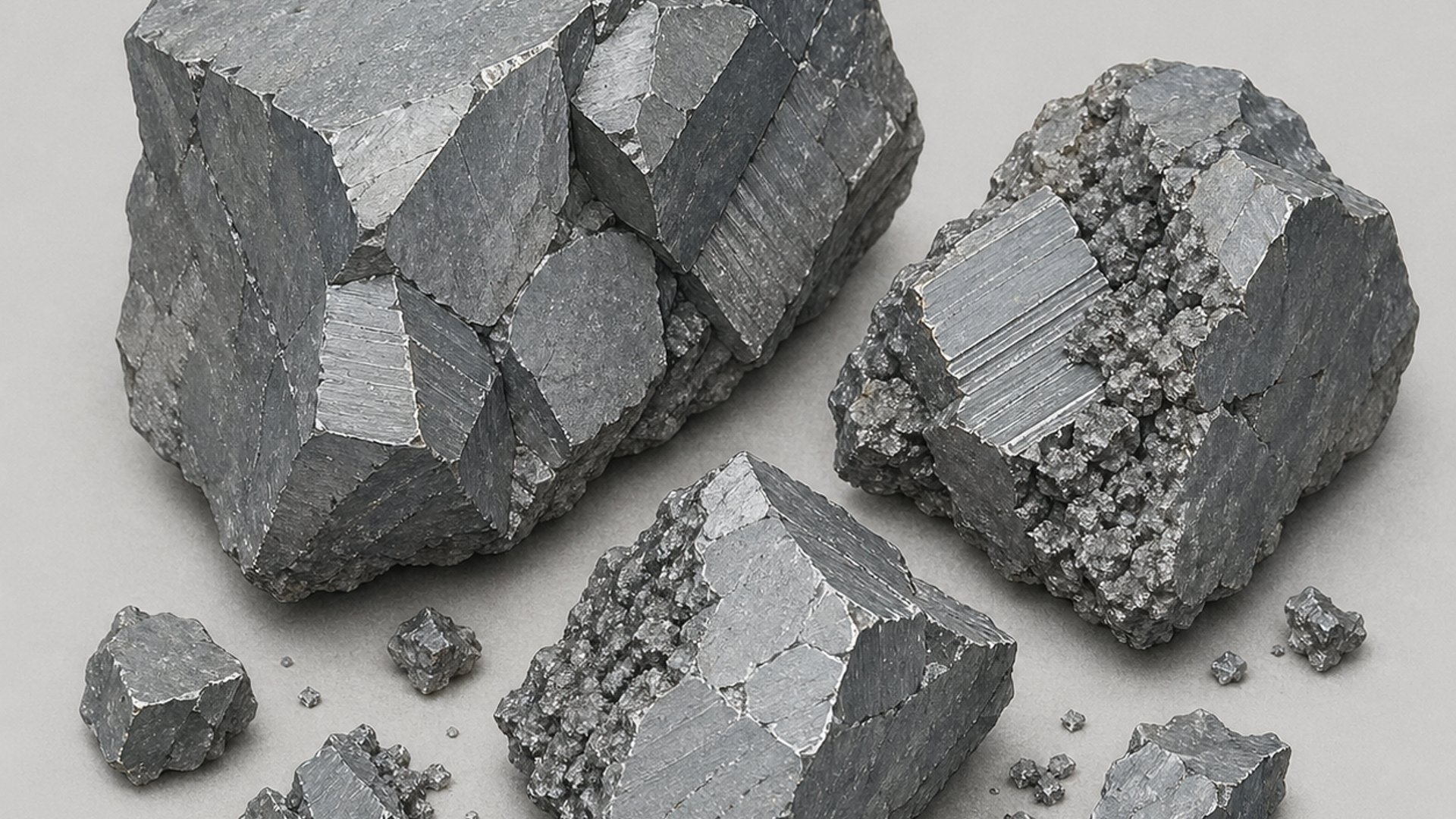
A research project by New Mexico State University student Jaden Love is shedding new light on gray tin, an unusual form of tin that behaves very differently from the metal most people know in everyday life. Love, part of the PREM center NMSU-UCSB Partnership for Research and Education on Quantum Materials and Processes (PREQ), studied thin films of gray tin and found that researchers can use a non-destructive optical method to estimate an important property known as carrier density. In simple terms, that means measuring how many charge-carrying particles can move through the material without damaging the sample.
Gray tin, also called α-Sn, interests researchers because of its unusual electronic structure. It is often described as a gapless semimetal, somewhere between a metal and a semiconductor, with an inverted band structure that gives it unusual behavior and allows measurable light-driven electronic transitions — making it especially interesting for quantum materials research.
To carry out the study, Love measured how two very thin gray tin films responded to infrared light as they were cooled from 300 kelvin to 10 kelvin. Both films were grown on indium antimonide, or InSb, but under different interface conditions. As a result, one sample was closer to gray tin’s natural state, while the other contained extra electrons that changed its electrical behavior.
Using infrared ellipsometry, Love was able to estimate carrier density without damaging the material. The results also showed that growth conditions, including the substrate and its surface preparation, can unintentionally affect the material’s electrical behavior and optical response.
That matters because the standard way to measure carrier density, known as the Hall effect, requires electrical testing in a magnetic field to determine how charge moves through a material. While widely used, Hall effect measurements can be difficult to set up and may damage delicate materials such as gray tin.
“Alternative methods for determining carrier density such as Hall effect measurements tend to be cumbersome to set up and ultimately are destructive to delicate materials such as gray tin,” says Love. “We have shown preliminarily that the non-destructive optical method can provide results that are consistent with Hall Effect measurements while still preserving the sample.”
For Love, the project also involved overcoming technical challenges in the lab. “I had previously focused on collecting temperature-dependent ellipsometry data for materials like germanium using liquid nitrogen cryogen,” she says. “This system was later upgraded to a closed loop helium system that could sustain a much lower base temperature for much longer, which was important for obtaining quality data for gray tin. I was excited to overcome the technical challenges of measuring these novel materials using a new system.”
Overall, the project points to a promising new way to study gray tin while preserving hard-to-make samples. “This project demonstrates a non-destructive method for determining the carrier density in gray tin films,” Love says. “The results obtained by our methods are in agreement with values found by Hall effect experiments, and we consider this a productive step in expanding the known techniques for determining carrier densities.”