By Divya Abhat, PREM Web Team
In a world where “nanotech” still sounds like science fiction (think Iron Man and his cutting-edge nanotech suit), researchers at Northern Arizona University (NAU) are building the real thing—one tiny “microswimmer” at a time.
Microswimmers—micron-sized particles—are a subcomponent of a field called active matter, and they have the ability to move, adapt, and work in complex environments, much like flocks of birds swarming through the skies or schools of fish swimming in an ocean. With this ability, microswimmers could potentially act like tiny, guided tools inside the body; for example, moving through blood vessels to locate a tumor, deliver a treatment, or help clear a blockage.
But at that infinitesimal scale, particles don’t move like a little submarine that can be steered. Instead, they get jostled randomly by constant collisions with surrounding molecules in the fluid, a phenomenon referred to as Brownian motion. So, instead of going straight to a target, they drift and wander unpredictably.
Keeping Them on Track
To address this, the team at NAU, part of the PREM award Materials Interfaces Research and Access (MIRA-PREM), has found a way to activate microswimmers in an efficient and targeted way. They recently published their research in the journal Small.
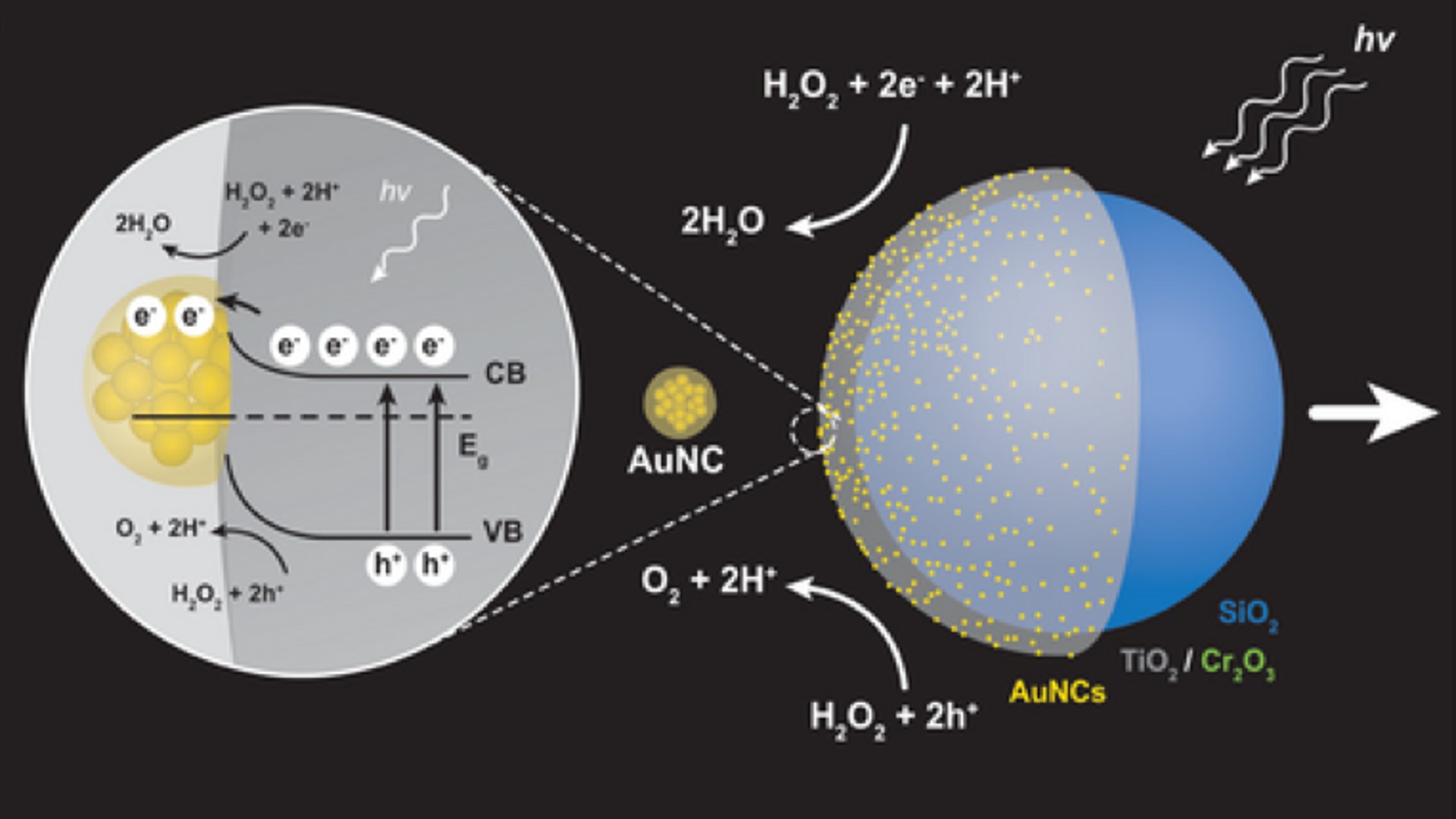
As part of this effort, the team coated Janus, or two-sided, microswimmers with titanium dioxide and atomically precise gold nanoclusters (AuNCs). These coated microswimmers were then put into water with hydrogen peroxide and illuminated with UV light. The light “turned on” the coating so it triggered chemical reactions. Because of the two-sided feature of the microswimmers, the reactions happened more on one side than the other—giving the particle a push through the liquid—like a kind of jet motor that helps it stay the course.
“We’re at that point of trying to figure out how we can control these types of particles so that we can do complex functional activities,” says Gabriel Montaño, Principal Investigator for MIRA-PREM, professor of applied physics and materials science, and an author on the paper.
The next step for this team is to further improve control: using different colors of light to tune the photocatalysis and steer microswimmers in different directions, and using patterning/clustering methods to place materials more precisely so the swimmers can move with accurate, multi-directional “A to B” navigation—even through complex 3D environments like mazes or the body.