By Divya Abhat, PREM Web Team
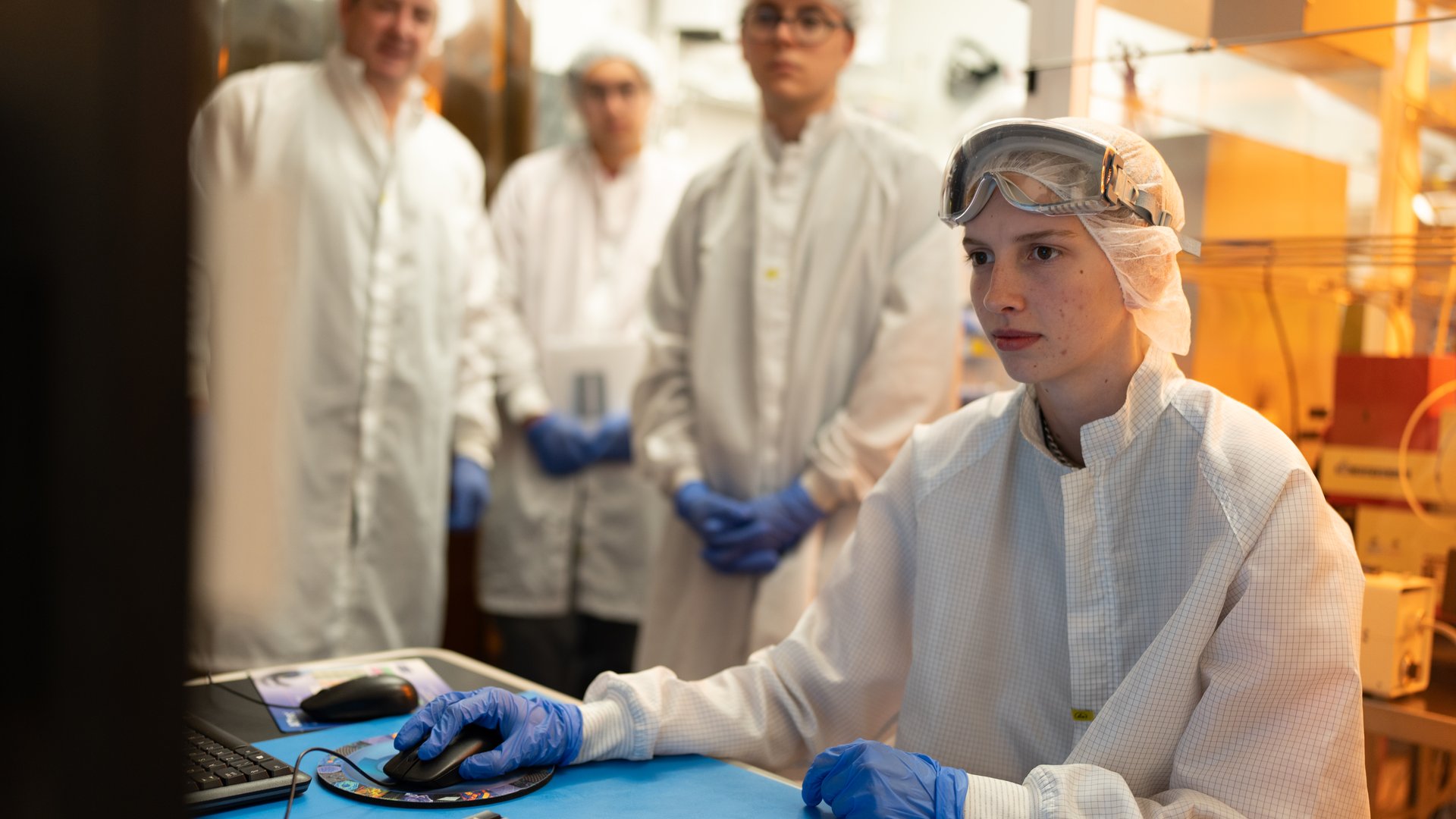
Sally Thompson, a senior at Fort Lewis College in Colorado, straddles two seemingly different disciplines: engineering and geology. In practice, though, the boundary blurs—especially in materials-focused work where microscopy, chemistry, and structure all shape how something behaves.
That’s precisely what appealed to Thompson when she chose to major in geology and minor in engineering in Jeff Jessing’s lab. Jessing is a physics and engineering professor at Fort Lewis and Principal Investigator for the PREM award, Partnership for Education and Advancement of Quantum and nano-Sciences (PEAQS). He also runs the Fort Lewis College Nano Lab, which focuses on nanofabrication, nanomaterials, and nanotechnology.
The combination also gives Thompson access to hands-on experiences in the field as well as rigorous lab work. Last year, for instance, Thompson went on a four-day trip to the San Juan River in Utah to learn about sedimentology and stratigraphy. After she graduates, she’ll spend a month in the field—moving through Moab and the Henry Mountains, then to Ouray, and the broader Four Corners region.
Making Silicon Behave Like a Lung
Back in the lab, Thompson’s research focus is on “lung-on-a-chip” research, which involves engineering a material—in this case a silicon membrane—to mimic the workings of a human lung. These wafers or chips not only reduce reliance on animal testing but also allow researchers to test how human cells and tissues respond in a controlled, organ-like environment—potentially enabling more personalized medication.
To do that, the team works to replicate the lung’s interstitial space—a critical interface where oxygen exchange occurs—at the correct scale. That space is about 1 micron thick (roughly 50–100 times thinner than a human hair), so their first hurdle was thinning silicon from about 275 microns (think 5-6 strands of hair) down to 1 micron.
“Our first two and a half years, we just focused on getting down to that thickness, because originally when I got here, they could replicate the 25-micron thickness, but that was still pretty far away from our target,” says Thompson. Through sheer persistence and hard work, the team ultimately found a way to thin the wafer to the desired thickness using a crystal-direction-dependent wet chemical etch.
The Porosity Breakthrough
Thinness alone wasn’t enough; the membrane also needed to be porous so it could behave more like a flexible, tissue-like barrier. The team could create pores in thicker samples using a “sandwiched” setup, but the thinnest membranes were too fragile for clamping.
Last summer, the team had a breakthrough when they found a way to create an electrochemical etch using hydrofluoric acid as an electrolyte. Doing away with the sandwich fixture, the resulting surface tension instead held the liquid in place on the delicate membrane.
Thompson will present that work at the spring MRS conference in Honolulu—her second time at MRS after Seattle in Spring 2024.
Opportunity, Momentum, Next Steps
For Thompson, the biggest draw of this research is its potential impact: reshaping how diseases are studied and treated. She’s also keenly aware of how unusual the pathway has been, thanks in large part to the PREM program. “I got my first publication at 19 years old,” she says. “Being able to do undergrad research is extremely rare … a lot of times those opportunities go to the graduate students.” She adds, “And so we’re very lucky we don’t have any graduate students, and we get so much hands-on experience.”
The PEAQS alumni “wall of fame” similarly speaks volumes for what these students have achieved as part of the program. Of its more than 80 graduates, 40 percent went onto graduate school (PhD, masters, or medical), 45 percent went into industry careers in STEM, 7 percent went to work at National Labs, and 8 percent went into other careers such as K12 education, patents office, and the military.
With all of these choices, after graduation, Thompson plans to slow down and use a year to scope out her options—and the shape of the life she wants to build next.